What do you consider the biggest (CX) game changer from your career so far?
1️⃣ I'd say the biggest game changer is still the very basics — looking at business through the customer's eyes. I used to be afraid of feedback. It's that feeling when you've worked on something you care about, and then you have to show it to someone from the outside, and you're scared the feedback will be negative. And it'll sting. But when you overcome that fear and let yourself receive feedback — ask customers what grabbed them about your solution/product, or what doesn't work for them — you get such great insights that you can never get enough of them. That's something I try to instil in both our team and clients at Proof.
2️⃣ And the second game changer — a next-level one, in my view — is looking for the economic rationale within CX. I don't like it when someone uses "customer experience" as a buzzword without being able to show its impact. The moment you look at the customer journey through the lens of conversions, revenue, or cost savings, and you combine that with customer feedback, you suddenly become very good at evaluating what makes sense to tackle first. What will bring in money. Whether to focus on helping customers choose a product, or on making the purchase itself as easy as possible (for example, in an e-shop or a store). Or whether to focus on keeping customers as well-informed as possible about where their order is right now (for example, because the product is expensive and the customer worries it might get lost in transit).

Is it possible to do good marketing with zero budget?
▶️ Practically speaking, I don't think it is. Marketing, just like CX, exists whether you're actively working on it or not. You'll always have some product, some price, some way of getting the product to people, and some way of communicating it — because otherwise no one will ever hear about it. And beyond that, even if you have no one working on marketing, as a founder you're still paying yourself. But the lower your investment in marketing, the longer it will take to see results. And maybe you never will. The question then is whether you have enough time to afford that. I could also imagine having a truly great product with a really strong community around it, where the product essentially sells itself through word of mouth. But that will be the exception, not the rule.
▶️ Marketing should always "return" the money invested in it. If you do it well — you're promising the right thing, solving the right problem with the right product, combining channels appropriately (because you have enough information about your customers), and you're using a sufficient budget to beat your competition — then you're safe. Marketing will bring in more money than you put into it.
Which Czech company has truly excellent CX?
1️⃣ Looking purely at e-shops, I'd say Datart, Rohlík, and Alza. They're great at meeting the expectations they set. They've done everything to ensure the customer is satisfied from the moment they arrive on the e-shop all the way through to receiving the product at home or in a pick-up point. Fast, convenient, and in a way that makes you feel they care about you. That you're not just a number. That's excellent. And some of them even have CX metrics directly tied to their employee motivation and reward systems. That's on a whole other level.
2️⃣ Outside of e-shops, in the world of products or services, I'd mention Liftago — I always prefer it over Uber or Bolt because I know I'll get a genuinely experienced and vetted driver. They promise that, and they've always delivered.
3️⃣ And lately I've also been really impressed by Česká spořitelna and their entire ecosystem around George banking. Most things can be handled through the app — I don't need to visit a branch — and when I do go in, they know practically everything about me that they need to do a great job. On top of that, Česká spořitelna has, in my view, really well-executed marketing communications. I admire how an organization this large can still feel human and fresh.
If you could pass a marketing law in the Czech Republic, what are the biggest marketing bad habits you'd ban across the board?
▶️ Nothing comes to mind immediately. But what genuinely infuriates me are dark patterns in UX, opaque pricing, excessive use of discounts, and fake reviews. And also a purely short-term view of marketing — measured through clicks, views, and so on — instead of focusing on how much money marketing is actually bringing into the company.
What would you do if you had to earn a living with your hands?
▶️ I'd open a bike repair shop. Or head off to the Alps to work as a ski lift operator or golf course groundskeeper. Though apart from the groundskeeper, I have no actual experience with any of the above — so I'm probably idealizing it and would get over it pretty quickly.
Bonus tips from Jakub on where he finds inspiration
✔️ Studies
CX study in the Czech Republic by KPMG
Brand vs. Performance study by WARC
✔️ Books I'm enjoying right now
The diary of a first-time CMO
The Effortless Experience: Conquering the New Battleground for Customer Loyalty
10x Is Easier Than 2x: How World-Class Entrepreneurs Achieve More by Doing Less
✔️ Newsletters & media
CzechCrunch and their newsletters
Marš by Marek Šulík
Newsletter by Pavlína Louženská
Articles from WIRED
✔️ AI tools I've tried recently
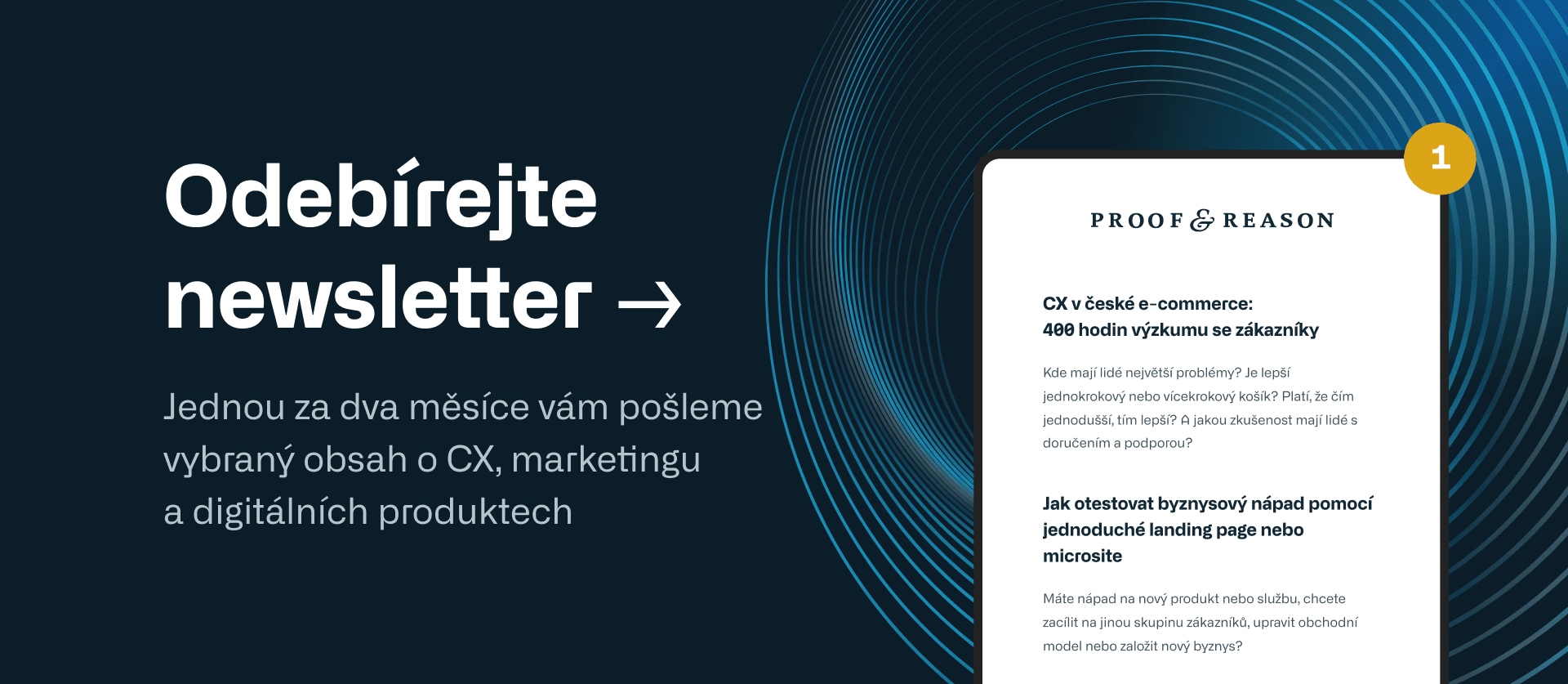
In it you'll find, for example:
- A video guide on how to create your own customer journey map to improve customer satisfaction
- A case study of e-shop Nazuby.cz, where a redesign increased the conversion rate, turnover, and profit — and just 8 months of the new e-shop's operation covered 7,000 hours of our work
- A step-by-step guide on how to kick off e-shop growth using secondary data
- The WARC report — not just for marketing managers — showing how performance advertising builds brand and brand advertising drives sales
- Or a simple checklist for running a webinar