Care for a cookie?
One of the major topics at this year’s edition was cookies and user privacy:
- Lukáš Čech from Activate talked about designing proper cookie consent collection.
- Antonín Kučera from Livesport shared how the shift to opt-in affected their numbers across different markets.
- I moderated a relaxed, mildly philosophical discussion on how much internet privacy should be regulated by legislation, what could fall under the remit of browsers — and what is ultimately up to the users themselves.
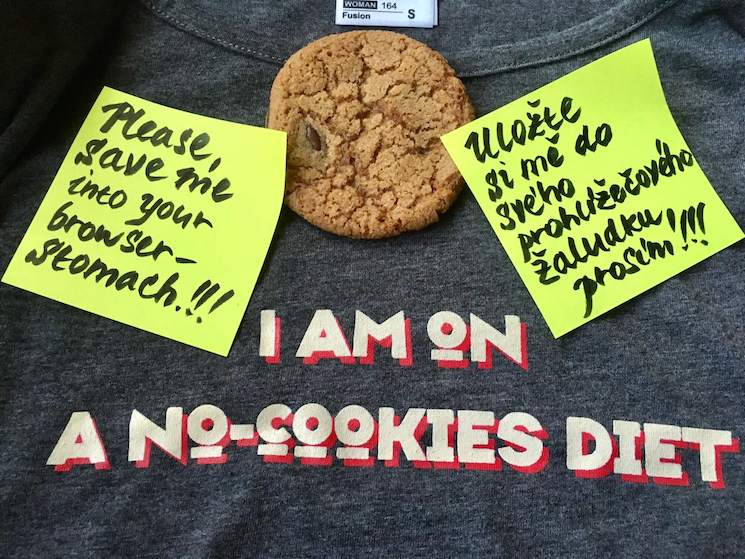
The cookie selection at the coffee breaks seemed to anticipate the theme. Fortunately, most attendees did not take the motif on this year’s t-shirts too literally — at least not while eating.
From JavaScript to SQL
The most fundamental skill of a technically-oriented web analyst has traditionally been JavaScript — you cannot get far with any advanced web analytics implementation without it. But since Google Analytics introduced its fourth-generation measurement tool, which exports data into BigQuery for free, SQL for querying databases has joined JavaScript as an essential skill.
Vašek Jelen presented basic work with analytics data in BigQuery, and Vojta Kurka shared more advanced SQL SELECT examples.
Study tip: If you are just learning BigQuery (and SQL) and do not have a good dataset to practice on, Google has published a sample dataset where you can safely explore GA4 data.
How to work better and more efficiently
Two major challenges keep coming up in my work:
- How to verify that what I am measuring is actually reaching the tool.
- How to properly spec the entire analytics setup for developers and keep documentation up to date.
Problem number 1 could be solved by Charles Proxy, which Kuba Kříž from Optimics demonstrated in practice. For debugging analytics on the web, the tools built into virtually all browsers might suffice — but as soon as you start dealing with mobile app analytics or internet communication in smart devices, Charles becomes very handy.
Internal wikis, shared documents, standardised naming… there are many approaches to documentation. But most of them are a pain to keep up to date — and discrepancies between the spec and reality quickly emerge. André Heller presented coda.io, a tool that could significantly ease the burden of documentation and technical specifications. Coda is best described as a system of interconnected tables, databases and text documents (a notch smarter than Notion, if you know that tool). It makes it easy to have business requirements, element definitions and specific implementation codes all in one place for developers.
And that is not all
Measurecamp topics were as varied as its attendees. The programme also covered:
- A group discussion on how to effectively drive adoption of a new (data) tool with clients.
- Rolling out Google Analytics 4 at Czech News Centre.
- More efficient computation in R.
- Automated bidding for PPC specialists.
- The journey to Data Discovery at Livesport.
- “Ask me anything” — an open Q&A session where André Heller shared his best practices.
See you next year
Many thanks to the organisers for a great opportunity to meet the analytics community in person (and take home another funny t-shirt and some great food).
What I really like about Measurecamp is the community spirit. Absolutely anyone can come with a talk or discussion — and attendees are happy to engage actively. It is also a welcoming environment in which to speak publicly (or gain a broader perspective on problems you are dealing with at work).
Looking forward to the next edition (and hoping it will be in person again).
Article by: Jan Kadlec, data analyst