We simplified navigation and discovery of target pages on the website by 48%, saving hundreds of thousands in customer support costs
When a customer helpline serves as a guide through the website, it means unnecessarily high costs per call. It also highlights the website’s shortcomings – in the case of E.ON Distribuce (now EG.D), it was the complicated site architecture. The upcoming rebranding of the entire E.ON group offered an opportunity to solve the problem.


EG.D, formerly E.ON Distribuce
- Manager and operator of the distribution network in South Bohemia and South Moravia.
- Approximately 2,000 employees.
- Part of the German E.ON group.
High call volumes and a complex website structure
Due to state regulations, energy distributors have limited opportunities to increase profits. They therefore often focus on reducing costs. For E.ON Distribuce, the call centre – the customer helpline – was a significant expense. The confusing website only drove call volumes even higher.
As we learned from the brief and confirmed through internal in-depth interviews, call centre staff very often served merely as website guides, directing clients to pages related to their requests. Instead of having time to address problems clients couldn’t solve on their own.
Project goals
Direct communication with customers is extremely costly for a company of this size. The main project goal was therefore to reduce the number of requests to the customer helpline and shift as much of the load to the website as possible.
„Customers call because they don’t know what to do or how, or because they can’t find something. Information on the website is poorly described, help texts and descriptions are hidden behind additional downloadable documents. This was because there was no systematic approach to content management, and too many people had a say in it.“

Digital Delivery Management, E.ON Distribuce
Through user research and testing, we established the rules for information architecture
To design a solution, we needed to understand user scenarios – the situations in which clients come to the website and the problems they encounter.
„We needed to understand how certain parts of operations work, when and in what situations people from customer support or people dealing with faults, power cuts and planned outages interact with the website.“
The client defined the target groups for creating the scenarios:
- end consumers (households, businesses), who according to further research are the largest group,
- electricity suppliers who have a contract with E.ON Distribuce and sell electricity to end consumers,
- municipalities that consume electricity,
- contractors, i.e. companies and contractual partners that provide services to E.ON Distribuce on demand, e.g. electrical work or construction modifications.
Website visitor types
From a sample of 1,208 visitors to www.eon-distribuce.cz, we identified the 5 most common visitor types, representing 93.3% of the sample.
= 2 visitors
76.0%
Households
8.9%
Small and medium businesses
3.5%
Large businesses
3.0%
Municipalities and cities
1.9%
Electricity suppliers
6.7%
Other visitors
Understanding user scenarios
To uncover individual website journey scenarios, we conducted in-depth interviews with customers and employees. We needed to understand how certain parts of operations work, when and in what situations people from customer support or those dealing with faults, power cuts and planned outages interact with the website.
We supplemented the in-depth interviews with additional data:
- interaction analysis using Hotjar heat maps,
- Google Analytics data analysis,
- and an expert website review.
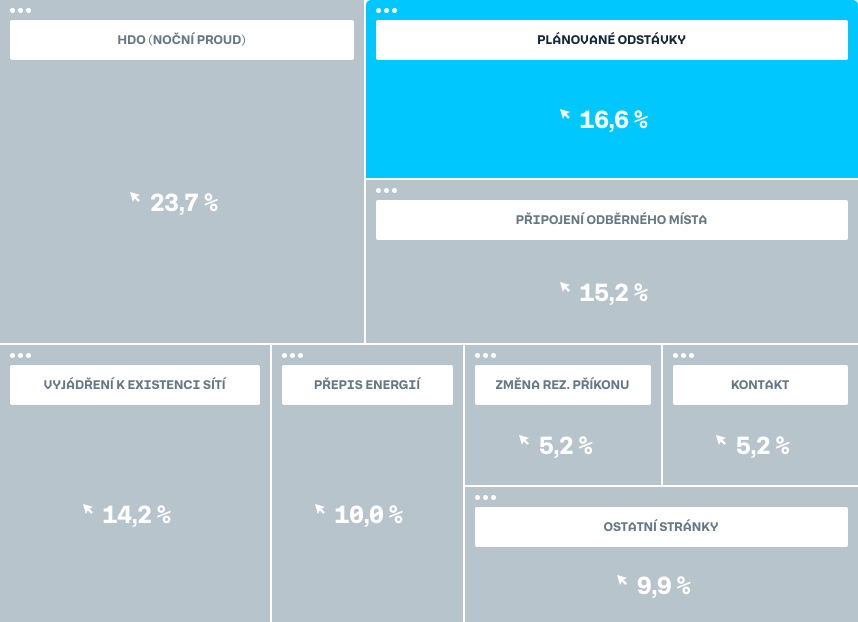
We identified a whole range of user scenarios. We linked them with call centre data and insights from a quantitative survey. The most common tasks customers perform on the website:
- looking up information about low electricity tariff times,
- checking information about faults and planned outages,
- wanting to set up a new connection for a home, cottage or business,
- needing a statement on the existence of utility networks on a plot for a building permit.
Website visitor goals
90.1% of website visitors searched for information on these 7 topics. In this case study, we focus on optimising the planned outages page.
Uncovering website problems
Through interviews and analysis, we also uncovered a number of problems with the original website:
- incomprehensible to customers, who did not connect the overly complex page names of requests with the problems they were trying to solve,
- complex terminology that users did not know and searched for under different names, e.g. the website term Ripple Control (HDO) was referred to by customers as night rate or low electricity tariff,
- difficult-to-read content, roughly 80% of pages were too technical, with unstructured texts,
- unclear request process that users did not understand – they did not know how to submit a request or what would follow.
We adapted the website to user needs
Based on our findings, we designed changes that have a fundamental impact on the current website performance:
- navigation hubs with examples of typical situations linking the complex official names of requests with how customers refer to them,
- humanising the content and communication style to make texts less technical and closer to the everyday language of end customers,
- a unified format for target pages across the entire website, consisting of three parts:
- what the request concerns, when it is needed and a list of documents the client will need to complete and submit the request,
- a call to action to submit the request, most often an online form or PDF with information on where to submit the request in person,
- a list of steps that follow after submitting the request, including time estimates.
- clear placement of sections and tools for other target groups who do not need to click through the website and are only looking for documents – for example, contractors search and filter documents in a dedicated Forms and Documents section.
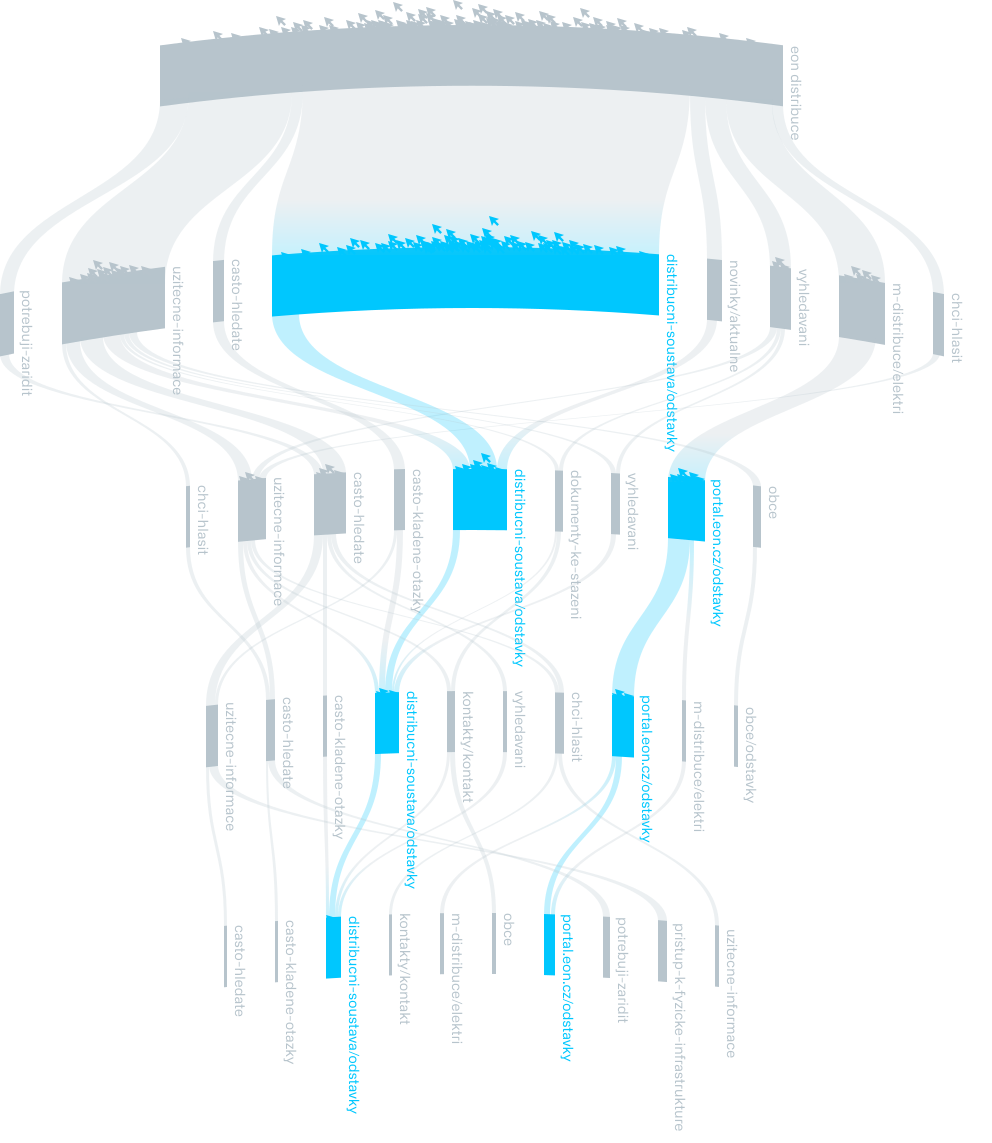
Testing the information architecture of the old and new website increased discoverability by 250%
Planned power outages are key information for customers. The goal of testing was to identify obstacles in finding the page and propose a solution to increase the number of visitors who find the page by at least 20%.
- = Visitors who found outage information
- = Visitors who did not find the information


Results? Easier discovery of target pages and 20% fewer call centre requests
Based on our findings, we designed changes that have a fundamental impact on the current website performance. At the turn of 2019 and 2020, we measured these changes resulting from our proposals.
+7.2%
Increase in forms submitted online by 7.2% compared to those sent by post. The original goal was to reach 80%. For some requests, this was exceeded – e.g. for network existence statements, the value was 84.1% in 2019 and 91.3% in April 2020.*
-20%
Reduction in call centre requests by 20%. Over the years of the project, call volumes continued to decrease and customers increasingly sought solutions to their requests directly on the website.
7x
Mobile device traffic increased by 700%. The new website is more usable on mobile and thanks to a logical structure, users can find the pages they need more quickly.
+48%
Increase in the success rate of finding target pages by 48%. Additionally, traffic to the two most important pages increased: Planned Outages by 250% and Low HDO Tariff (night rate) by nearly 100%.
* For other requests, the trend toward electronic submission is also growing, but circumstances often do not allow such a high percentage. E.g. a new connection request is submitted online in 62.1% of cases, a request to change reserved capacity / circuit breaker value in 59.6% of cases.
The website optimisation was also recognised by expert juries
Optimisation? Redesign? Simpler system for partners? Digital transformation?
Let's discuss what you're currently facing
Don't want to wait? Call +420 604 122 182 or email tomas.izak@proofreason.com

Tomáš Izák
CEO