What a customer journey is and why it's more complex than you think
Imagine following a customer as they go from idea to purchase and then to either delight or frustration. And writing a travelogue about it. A customer journey is essentially the story of how people buy from you. And more importantly, why they do what they do.
„Only 1 in 26 dissatisfied customers will tell you there was a problem. The rest will quietly drift to your competitors."
What a customer journey is not: a sketch of how someone navigates your e-shop. Five stories from the front desk. A log of calls from the call center. But it's exactly from things like this (and many others) that you piece it together. Because if you want to truly understand your customers, you need to look at what they ask their friends, when they compare you to competitors, what they look at on your website, and why they give you different ratings on Maps versus Google.
Only once you've mapped, described, and understood all of this can you truly meet customers where they are. And take a step toward a better customer experience.
Because you'll know:
- what your customers want,
- what they're afraid of before buying and what motivates them,
- how they feel while shopping with you,
- and most importantly, you can start thinking about what would help them feel more satisfied.
What does this mean in practice?
Where a customer journey map will take you
We've already said that a map can help you more easily guide your customers toward a better experience. What's in it for you? Do you hope for more customers, higher revenue, and more money? Honestly: all of that is possible. It depends on what you map and what you do with the map. Let's look at some examples right away.
5 + 1 examples of what mapping can help with
- Turn prospects into clients. Once you uncover your customers' motivations, you can target marketing and sales strategies more precisely. That means fewer drop-offs and a better conversion rate.
- Increase competitiveness. With the customer journey mapped, you can adapt more effectively to what people want. You'll have an advantage over slower-moving competitors.
- Save your own resources. A deeper understanding of when customers need help or a nudge allows you to plan better — your marketing, sales, and customer support.
- Choose the right marketing channels. You'll realize where your customers are and why they're there. You'll find out which channels to invest in, and which you may not need at all.
- Solve problems before they get out of hand. With a customer journey map, you have a clearer picture of what might be going wrong, how serious it is, and why. So you can more easily identify the areas that need the most attention right now — and you'll often already have an idea of how to address them.
„61% of companies surveyed believe they deliver a top-class customer experience. But only 23% of customers agree."
+1 Increase retention, and with it profits. When you find out what people do with you and what problems they encounter along the way, you can serve them better. Then they'll be happy to come back, and they'll recommend you too.
„Retaining just 5% more customers can increase your profits by up to 95%."
And the most important thing it will definitely help with
Creating the map, above all, forces you to look at your entire company through the eyes of your customers. And not just you — because you need to involve other colleagues in the process too. Everyone will claim their department is customer-first or customer-centric — or both — but it often turns out that everyone has a different idea of what that means. Like the idea that replying to customer emails by the next business day is fine, as long as it does get done.
It's not enough.
„A third of customers expect a reply within an hour. But it takes companies an average of 12."
The map helps you align expectations and processes as a team. And it leaves you with a binding output that everyone agreed on and that you can return to whenever things start to go wrong.
6 steps that (almost) every customer takes
Every customer journey is different, because different people solve different things with you. Attracting customers to a new investment platform as a startup is not the same as them coming to return expired kimchi. But don't worry — we have the most common stages that appear in various forms on customer maps.

- Awareness. The customer has a problem and discovers that you might have one of the answers. Here you're mainly interested in what the customer is dealing with and why — what's behind their problem, why they want to address it now, and what they're afraid of.
→ The customer wants to eat healthier. Maybe they want to lose weight. They're worried it might be something more serious. And along the way, they found your online kimchi shop. - Consideration. The customer is deciding whether your solution is right for them. They look at the website, at competitors, read reviews, and ask questions. What do you think — do people know about you and would they recommend you? Does the customer know everything they need to know? Is it enough for them to choose you?
→ The customer is unsure whether your kimchi is right for them. They're finding out more about what kimchi does, looking for comparisons and reviews of your products, asking people around them, and so on. - Order. The customer has decided to go with you. But now they need to actually place an order. Is it smooth with you?
→ The customer is confident your kimchi will benefit them. They place an order and select delivery. - Delivery. The customer is waiting for you to deliver their order. And it doesn't matter whether it's kimchi, software, or login credentials. What are they dealing with in the meantime? Are you helping them feel at ease?
→ The customer wants regular, accurate updates on what's happening with their order. Is the kimchi packed? Has the courier picked it up? Or will you be fermenting it for another week? - Experience. The customer has what they wanted — and they've also gained an experience. If it was good, it's easier to win them over for future purchases. And if it was bad, you can try to make it right. It works!
→ If everything went smoothly, the customer will be happy. If not, it helps to have a plan. Maybe send a newsletter about how the beneficial effects on digestion show up with long-term use and offer a discounted subscription? - Sharing. The customer might tell the world about you. The more delighted or angry they are, the more likely. You naturally want them to say only good things. But are you doing anything to make that happen?
→ You can follow up: ask for feedback, offer an improvement, ask for a share.
You already know all of this?
Good. Because it'll come in handy when you're mapping. Similar points will form the foundation to build on. But watch out — you always map 3 things simultaneously.
- Actions. What the customer does and where.
- Thoughts. What they need, what they're hesitant about, what they're afraid of.
- Emotions. And how they feel throughout.
The fact that you see all of this together in one place is precisely what makes a customer journey map such a powerful tool.
And so you don't get tangled up in that triple net of detours, perspectives, and thoughts, you need to know exactly why you're making the map and whose journey you're tracking.
What to prepare before mapping, so you don't wander aimlessly
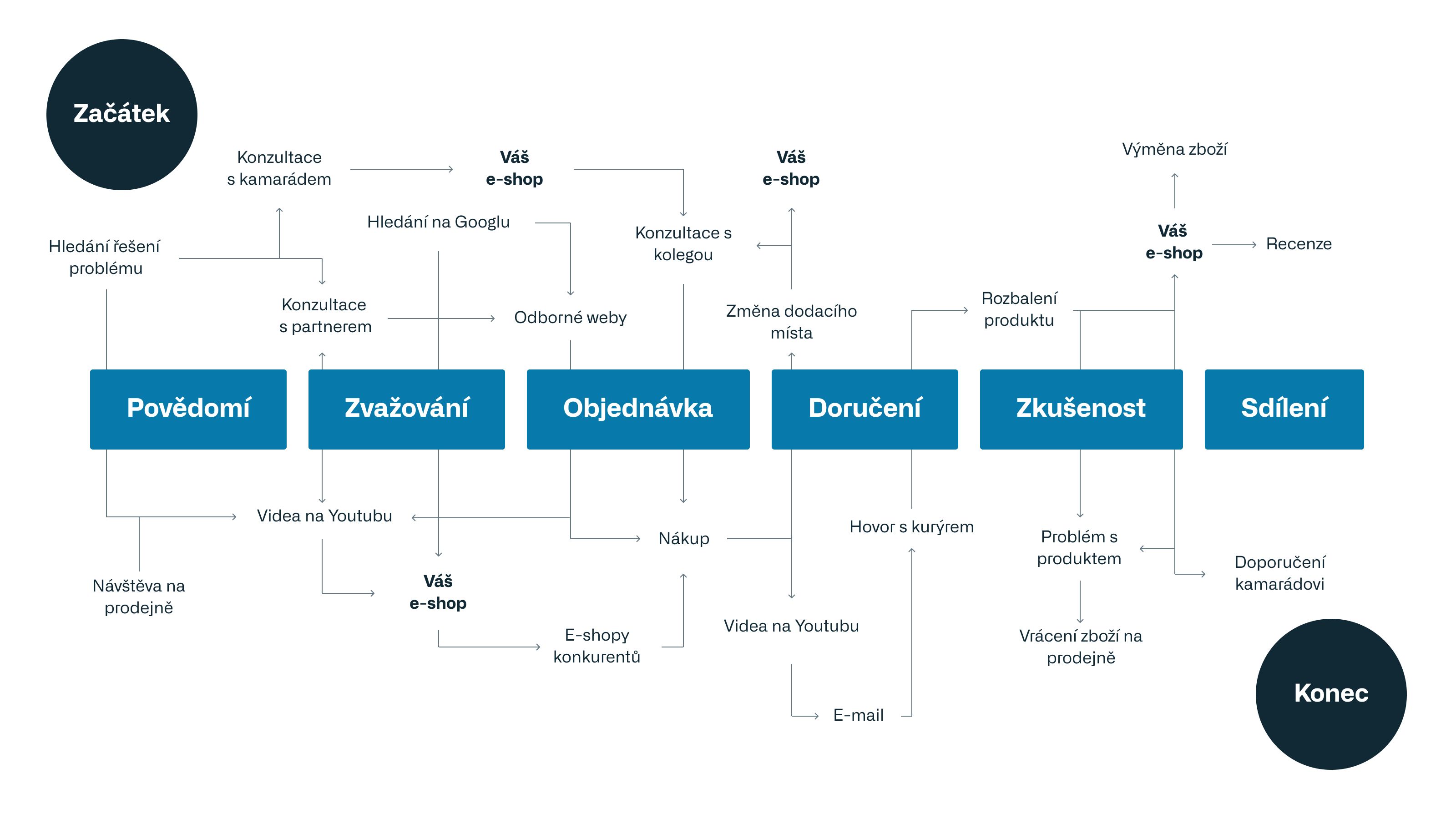
We've already mentioned that the map can help you address a wide variety of problems. And the customer journeys of different groups of people can differ significantly. So to ensure you're mapping what will actually help you, you first need to define three things.
- The goal of the mapping. What you want to find out from the map. This determines the breadth and depth you'll go to. For example, if you're primarily interested in why people complain about slow refunds, you don't need to map the entire pre-purchase decision process. It's enough to focus specifically on refunds and go through those processes in depth. Conversely, when mapping a longer stretch, you don't always need to explore everything to the last detail. Example goals:
- Create an end-to-end overview of the service experience to identify our weak and blind spots.
- Improve the refund process, because customer support tells us it's a major source of customer frustration.
- Identify the reasons for cart abandonment, because our data shows many people dropping off during the purchase process and we need to identify where to focus our development.
- Which customer group you're mapping. There's no point in trying to capture everyone at once — quite the opposite. The more precisely defined the target group, the easier the work and better the results.
- Brokers see your investment startup differently than people who only know a savings account.
- There's a difference between customers buying your novels for themselves versus as a gift for someone close.
- The motivations and concerns for visiting a café can vary significantly depending on whether someone wants to eat, is going for a business meeting, or is taking their two-year-old child.
- The scenario of the situation you want to map. That is, what your customer is dealing with and why. The scenario immediately gives you a clearer sense of which part of the customer journey you're mapping and what you'll be filling in. It might be:
- When a customer orders food from you for the first time and wants to make a complaint because the wrong order was delivered.
- When a parent wants to buy their three-year-old their first real bicycle.
- When a car owner skids, crashes into a tree, and immediately wants to file an insurance claim.
Once you're clear on all this, you put heads and data together. Because now the real work begins.
- You need to decide who should be involved in creating the map.
- You need to clarify what you already know about your customers.
- And who in your company might know what you don't.
- Yes, you may need to do some research.
- Or shop from yourself.
- And only then can you start drawing.
Is it shaping up to be bigger than you expected? That often happens with maps. That's why we have 2 things that will help you with mapping.
Start right now with our template, or watch the free video tutorial
If you want to take the first step right now, we have a customer journey map template on the Miro platform. You can copy it and start getting familiar with what's involved when filling it in. Or dive straight in, if you've already worked through all the previous questions. Filling it in blindly is only recommended if you want to try out the process and aren't expecting meaningful outputs. Those are only guaranteed when you fill in the map with things you actually know about your customers and can back up — not just impressions and assumptions.
The templates are free to use, but we'd love to hear whether and how they helped you.
And if you're not quite ready to fill it in yet, we have a detailed video tutorial for you. It will take you step by step through everything you need.
- What data you'll need to create the map.
- Where to get that data.
- Who to involve in the mapping process.
- How to fill in the entire map.
- What to do with it afterwards.
- And much more.
So if you're already planning and starting to think about a mapping workshop at your company, the video will help you prepare so that the result comes out with as little distortion as possible.