Key takeaways from the article:
- Secondary data can help you develop your e-shop or website and address the most critical usability issues.
- They simplify the creation of standardized elements and common patterns, such as e-shop flows including product filtering, product detail layout, or the individual steps of the checkout process.
- However, don't rely on secondary data when designing specific features or content unique to your industry or target audience.
- Always verify features and patterns designed based on general secondary data through user research with your target audience.
What is secondary data and where does it come from
We define secondary data as any information that was not processed for a specific project. This includes data from our own earlier research, as well as data that others have processed and made available.
There is a wealth of processed data we can access — from large academic studies and expert articles to research datasets. Quality varies, so it's important to draw from verified sources. We most commonly use:
- studies and research, for example from Nielsen Norman Group or Baymard Institute,
- case studies from comparable projects,
- books and articles with best-practice examples in a given area.
„We've compiled a list of quality secondary data sources you can draw on for e-shop development in a separate article."
User research or secondary data?
We always emphasize the value of user testing and research. We stand by the fact that in the long-term development of websites, its role is irreplaceable. At the same time, we know that it's not always the right place to start. It's often more effective to first look at secondary data and build on it, so we're not wasting time reinventing what's already known.
User research can be problematic at this stage because:
- you'll identify where the website's problems are, but the results typically won't point to a specific solution,
- to get quality, minimally biased results, you need a representative sample across all target groups — the full research process is costly and time-consuming,
- if you conduct the research yourself, you need to ask the right questions and interpret the answers correctly; otherwise, you'll end up with information that tells you nothing and can't be used as a foundation for solutions.
Working with secondary data, on the other hand, is:
- inexpensive — initial costs start in the low tens of thousands,
- fast — not just in terms of use, but also in results — the first ones come within a few months,
- effective — depending on the starting point, these initial results can already achieve a 10–20% increase in conversion rate without any additional interventions.
When it's appropriate to use secondary data
Of course, using secondary data also carries risks you need to weigh:
- You get a more representative sample than if you conducted the research yourself. But you won't account for your specific target audience.
- You're using processed data — no need to recruit respondents, manage the research, or interpret testing. But the data covers general features and patterns that apply across e-shops. It won't give you insights specific to your product or customers.
- Along with insights, you also get instructions on how to design the e-shop to work well. But don't treat them as gospel — test and evaluate all changes.
Secondary data is excellent for designing standardized elements and patterns that users already know and expect. That's why it works so well for website and e-shop design, which are largely standardized. Applying these universally applicable rules works and makes the experience easier for visitors.

This is explained by Jakob's Law — users spend most of their time on other websites, so yours will feel easier to use if it works similarly. Thanks to this principle, you can apply data from testing other e-shops to improve your own and use similar filtering principles, product listings, comparable layouts, and the same checkout steps.

„There's no need to reinvent the wheel. If we can use a study that tells us in a tenth of the time what we'd find through research, we use it. The saved time and money are then invested in researching specific problems whose solutions can't be found in general studies."
So if you have an e-shop whose performance is stalling or even declining, secondary data can help you significantly. Similarly, when initially designing an e-shop, you can apply the principles that e-shops commonly use and that users are already familiar with.
On the other hand, when you want to understand what content users expect on a website and how they think about it, secondary data starts to fall short. Content is driven by your users' motivations, needs, and fears — and those you can only uncover through research.
„Not every project can start with secondary data alone. If we need specific information about a particular product or target audience, there's no point wasting time on general recommendations — we go straight to primary research."
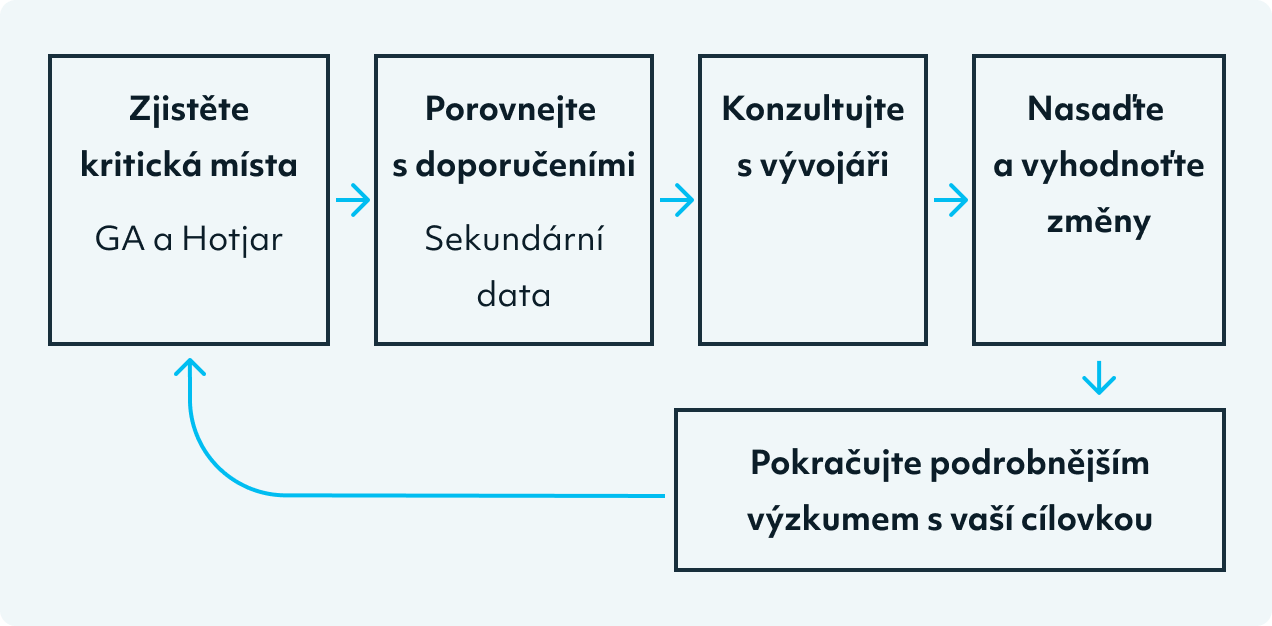
How to kickstart e-shop growth with secondary data — a step-by-step process:
1. Gather data on your existing e-shop's traffic
The volume of secondary data is enormous. Baymard Institute alone offers hundreds of specific <b>recommendations</b><divider>Baymard Institute focuses on identifying commonly problematic areas on e-shops and how to fix them. Their work is based on extensive user testing and surveys across nearly 200 e-shops worldwide.. Applying all of them would take enormous time and resources. To be effective, you need to select the recommendations that will have the greatest impact on your website's performance.
That means you first need to identify where your e-shop has problems. Traffic data will reveal this — you can collect it using the following tools:
- Google Analytics gives you a broad overview of the critical points in your e-shop (the places with the highest volume of users and the highest percentage of drop-offs — focus on the areas closest to the conversion action, working backwards from the checkout process through the cart to product pages and beyond). Review the results with an analyst.
- Hotjar, Smartlook, or similar tools generate page heatmaps and anonymized session recordings, helping you pinpoint how users behave on the site, where they spend time, and where they run into problems.
The data you collect will help you identify where problems occur. If no such areas emerge from this data and an analyst confirms it, secondary data probably won't help you — proceed directly to user testing with your target audience.
2. Compare weak spots against recommendations
Compare the problematic areas against solutions recommended by Baymard or NN Group, for example. Does your design diverge from the recommendation? Then you know what to change and how.
Always assess the feasibility of changes. If they're complex, they'll cost more effort and money than you expected. Discuss planned changes with developers and prioritize recommendations that are effective and deliver results as quickly and cost-efficiently as possible.
3. Test and evaluate whether the changes work
Secondary data is easy to use, and it's easy to start feeling like you now know everything important. Don't forget that secondary data is general — there's no guarantee that standards that work across the internet will also apply to your website. There's also the risk of bias, where you over-rely on your own judgment, which may be flawed.
„Universally applicable secondary data may not apply in your specific case. You eliminate this risk through testing."
Always evaluate your designs after implementation to understand which changes work better and which less. If you're using secondary data beyond the initial fix of the most critical issues, we recommend combining it with user testing with your specific target audience.
You still need user research
When used correctly and in the right situations, secondary data can help you make changes quickly, easily, and affordably that will move the website forward significantly.
They're therefore a particularly useful tool when time is pressing or your budget is limited at the start of a project. By using secondary data, you address the most critical usability problems — which in turn can help boost e-shop revenue, which you can then invest in research with your target audience.
Primary research is an integral part of using secondary data. No study or best-practice example, however good, can replace it. So don't rely solely on secondary data and don't try to build an entire project on them.
„Primary research is still the cornerstone of the entire project. Only through primary research and user testing can we build a truly high-performing and effective website."